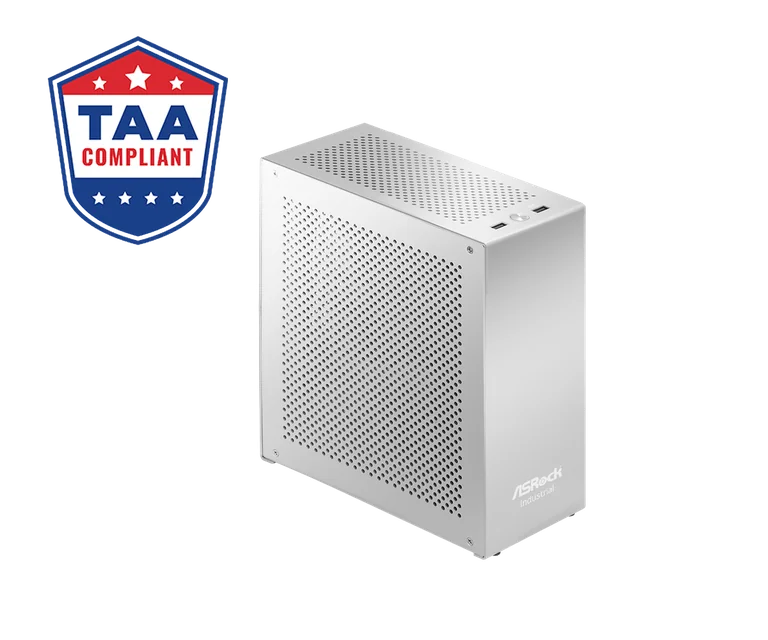
Local AI has moved from experimental hobby to practical daily tool for many people. Running large language models, image generation, or private assistants at home requires machines with high memory bandwidth, solid multi-core performance, and enough RAM to keep models resident. Among the current wave of AMD Ryzen AI Max+ “Strix Halo” systems, the ASRock Industrial AI Box A395 stands out as one of the most complete packages tested so far.
ServeTheHome recently reviewed the A395 and concluded it may be the most well-rounded Strix Halo box they have evaluated. Here is a clear look at what the system offers, where it shines, and the practical trade-offs.
What Is the ASRock Industrial AI Box A395?
The A395 is a small-form-factor system built around the AMD Ryzen AI Max+ 395 processor (Strix Halo architecture). The reviewed configuration comes with 128 GB of LPDDR5X memory. This high-bandwidth, soldered memory is one of the main reasons Strix Halo platforms are attractive for local AI workloads: large models can stay in memory without constant swapping.
In size, the A395 sits close to the Framework Desktop. It is slightly longer but a bit less deep, making it easy to place on a desk or mount in a compact workspace. A small top handle makes it convenient to move between locations.
Strong Connectivity for a Mini PC
One of the A395’s biggest strengths is its I/O. The rear panel is particularly well equipped:
- Two HDMI ports
- Multiple USB4 / USB-C ports (including DisplayPort output capability)
- USB 3.2 Gen 2 Type-A ports
- One 10 GbE port (Marvell AQC113)
- One 2.5 GbE port (Realtek)
- Wi-Fi 7
- Dual audio jacks
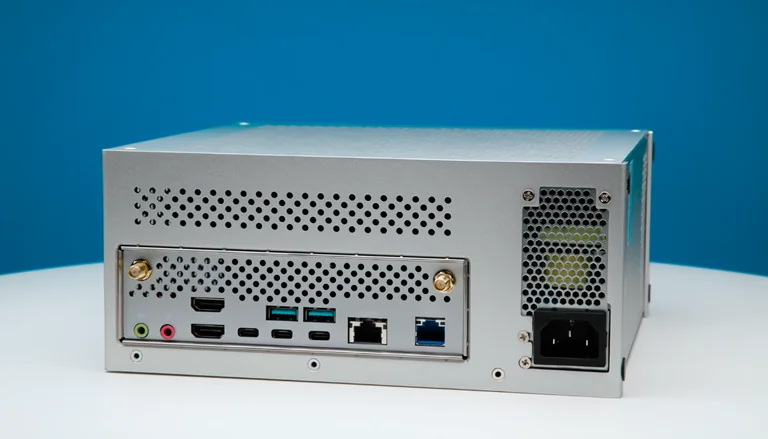
The system can drive multiple displays at once. Clear port labeling is another practical plus—ASRock Industrial appears to have listened to earlier feedback about confusing rear panels on some of their machines.
Internally, the design includes dual BIOS, a watchdog timer, and an MCIO connector, features that appeal to users who want higher reliability for always-on operation.
Performance and Local AI Use
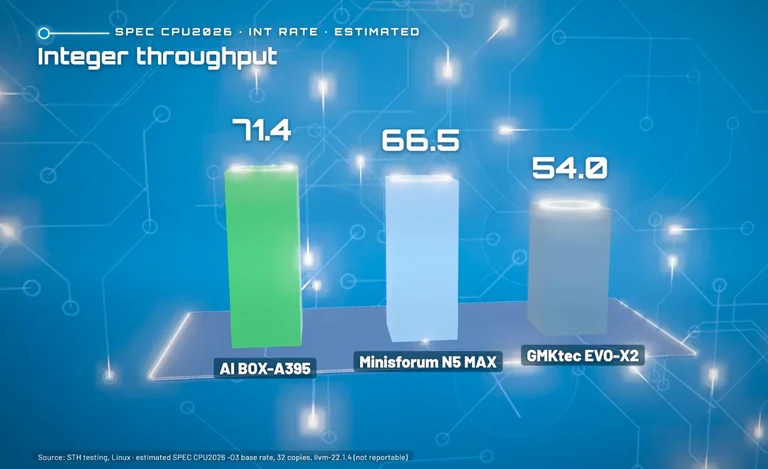
ServeTheHome ran a range of benchmarks, including SPEC CPU, SPECviewperf, and local LLM tests. The combination of the Ryzen AI Max+ 395 and 128 GB of fast LPDDR5X memory delivers strong results for running large language models locally. High memory capacity and bandwidth matter more than peak GPU TFLOPS for many current LLM inference workloads, and the A395 is well positioned in that regard.
Power consumption and noise levels are described as reasonable for a system in this performance class. It is quiet enough for desk use while remaining capable enough to serve as a small always-on AI node.
How It Compares to Alternatives
The reviewer directly compared the A395 with the Framework Desktop and several other Strix Halo mini PCs (GMKtec, Minisforum, Beelink, and others). While each system has its strengths, the A395 scored highly for overall balance: good thermals, excellent networking, flexible display outputs, and thoughtful industrial features without excessive bulk.
Framework Desktop remains attractive for users who prioritize repairability and modularity. Some other mini PCs may offer slightly different port combinations or lower prices. The A395’s combination of 10 GbE, multiple high-speed USB4 ports, dual BIOS, and strong labeling gives it an edge for users who want a dependable local AI workstation rather than a pure gaming or general-purpose mini PC.
Who Should Consider the A395?
This system makes the most sense for:
- Users who want to run larger local LLMs (70B-class models or multiple smaller models simultaneously)
- People building a quiet, always-on home AI server
- Anyone who values good wired networking (10 GbE) and flexible display outputs in a compact chassis
- Small labs or edge deployments that benefit from dual BIOS and watchdog features
It is less ideal if you need easy user-upgradable memory (the LPDDR5X is soldered) or if maximum discrete GPU performance is the priority.
The Practical Takeaway
The ASRock Industrial AI Box A395 is not the cheapest Strix Halo system, nor the most modular. What it offers instead is a polished, well-connected, and thoughtfully engineered package that feels ready for real daily use as a local AI box. After testing more than a dozen similar machines, ServeTheHome’s reviewer found it one of the most complete options currently available.
For users who want strong local inference performance, high memory capacity, excellent I/O, and industrial-grade reliability features in a relatively compact chassis, the A395 deserves serious consideration. It represents a mature step in the rapid evolution of small, high-memory AI workstations based on AMD’s Strix Halo platform.