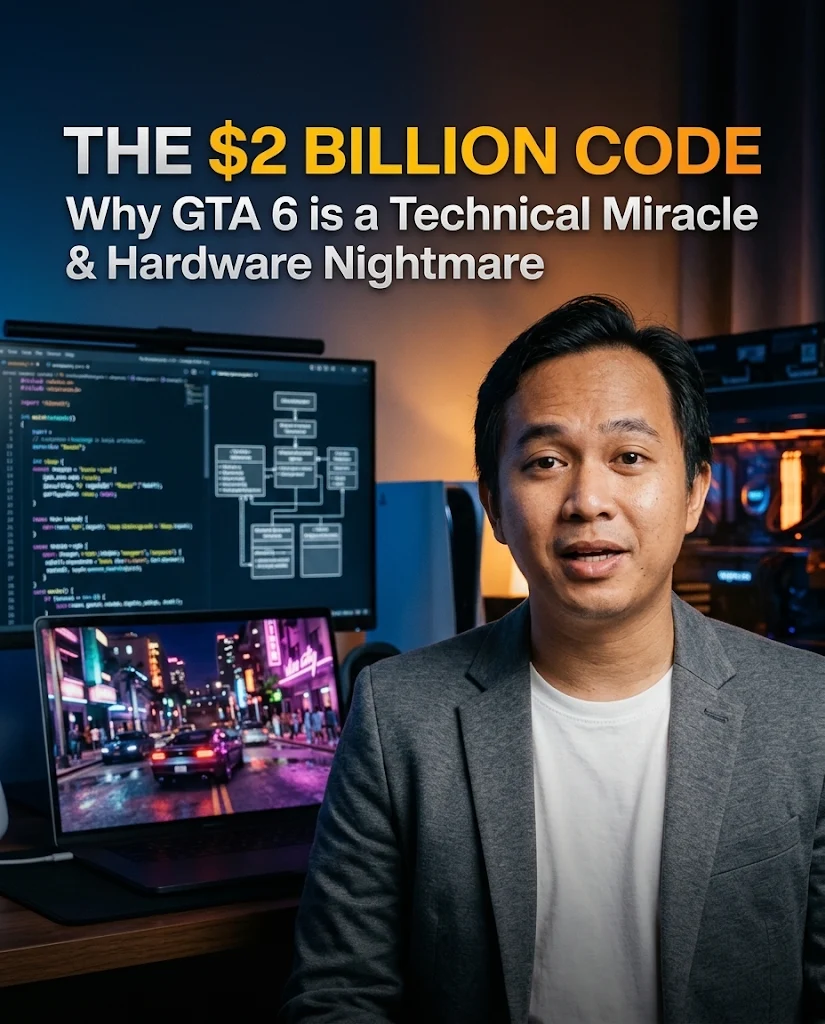
The world is currently obsessed with the trailer frames of GTA 6, but as someone who looks at the skeleton underneath the skin, I find the math far more terrifying than the graphics. We are looking at a game that aims to redefine “living world” while being strangled by the current limitations of console hardware.
When you are cruising through Vice City, every 33 milliseconds, your PS5 has to play God. It has to decide where thousands of NPCs are walking, how the light reflects off a rain-slicked pavement, and whether a stray bullet hits a gas tank. If the engine misses that 33ms window, the illusion breaks.
Here is the reality of the tech stack keeping this massive simulation from collapsing under its own weight.
The RAGE Engine and the C++ Obsession
While the rest of the industry is flocking toward Unreal Engine 5 for its shiny Nanite and Lumen features, Rockstar remains fiercely independent with their RAGE (Rockstar Advanced Game Engine). They have been refining this since 2006, and for a good reason. When you are building a game at this scale, off-the-shelf solutions are often too heavy or too rigid.

RAGE is built primarily in C++. In an era where many developers are moving toward higher level languages or visual scripting, C++ remains the king of “bare metal” programming. It gives Rockstar control over every single byte of memory and every microsecond of CPU time. However, I have a skeptical take on this: Rockstar’s insistence on their own engine is as much about control and avoiding licensing fees as it is about performance. It creates a “walled garden” where only those who have spent a decade at the company truly understand how to fix a bug in the physics pipeline.
The Memory Paradox: 16GB vs 200GB
The PS5 has 16GB of RAM. GTA 6 is expected to take up over 200GB of storage. This is a fundamental architectural nightmare. You cannot fit a city into a thimble.
The solution is a process called “streaming.” The RAGE engine is constantly talking to the SSD, predicting where you are going to drive three seconds before you get there. It loads the high-resolution textures of the neon signs in front of you while simultaneously purging the data for the alleyway you just left behind. If you have ever seen “pop-in” in an open world game, that is the engine failing to win its race against the SSD.
With the sheer density shown in the GTA 6 trailers, Rockstar is betting everything on the speed of NVMe drives. If those drives throttle, the whole simulation stutters.
The 30fps Controversy: Is the CPU Dead on Arrival?
Here is the controversial pill that many fans don’t want to swallow: GTA 6 will likely run at 30 frames per second on the base PS5, and potentially even the PS5 Pro.
The bottleneck isn’t the GPU; it’s the CPU. Rockstar’s simulation logic, the AI paths for hundreds of pedestrians, the complex traffic flow, and the “Euphoria” physics system that makes bodies react realistically to impact, all run on the CPU. According to recent technical breakdowns by experts like Digital Foundry, even the PS5 Pro’s boosted CPU clock speed isn’t enough to jump from a complex 30fps simulation to a stable 60fps.
Rockstar is prioritizing “density” over “fluidity.” They would rather have a city that feels alive at 30fps than a ghost town that runs at 60fps. It is a creative choice that pushes hardware to its absolute breaking point, but it also shows how stagnant console CPU growth has become.
Hybrid Ray Tracing and the GPU Dance
Visually, GTA 6 is using a hybrid approach to lighting. Pure ray tracing (tracing every photon of light) is too expensive for any current console. Instead, Rockstar uses “Global Illumination” and ray-traced reflections for key surfaces like water and car paint, while using older, baked-in techniques for less important areas.
This is where the magic happens. The engine decides, frame by frame, what deserves a “real” ray of light and what can get away with a “faked” shadow. It is a constant game of smoke and mirrors managed by the GPU.
The Hidden Stack: Perforce, Maya, and Houdini
The tech stack isn’t just what’s on your console. It is how the game is built. Rockstar uses Maya and Houdini for their 3D assets, but the real hero (or villain) is Perforce.
In a typical software job, we use Git. But Git is terrible at handling 50GB 3D models. Perforce allows Rockstar’s thousands of artists to “lock” a file, meaning if one artist is working on Lucia’s character model, nobody else can touch it. It is an old school, rigid way of working that prevents the “merge conflicts from hell” that would otherwise destroy a project of this magnitude.
The Verdict
GTA 6 is a testament to what happens when you throw unlimited money at a custom engine to bypass the limitations of aging hardware. It is a beautiful, bloated, and incredibly complex machine. But let’s be honest: we are reaching the limit of what silicon can do. If GTA 6 can’t hit 60fps on a “Pro” console, we aren’t just looking at a software problem, we are looking at the end of the exponential growth era for gaming hardware.
Source: https://youtu.be/9wXdEXdKGbU