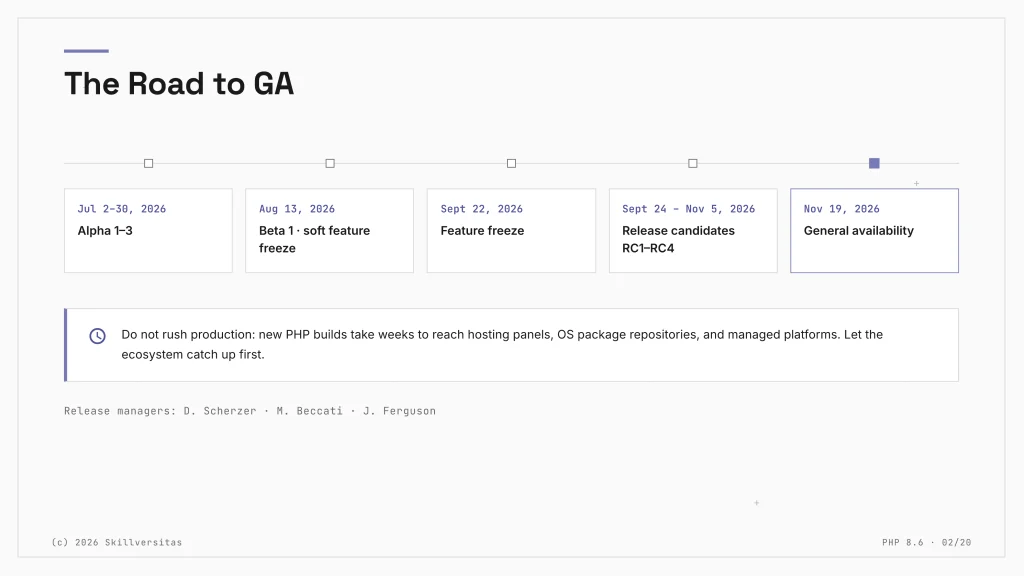
PHP 8.6 is here. The general availability build landed on November 19, 2026, right on the schedule the release managers promised, and it’s the release we’ve been running on our staging environments since the first release candidates in September. Feature freeze hit on September 22, the final RC shipped in early November, and now the GA tag is out.
If you’re waiting for it to appear on your hosting panel or your operating system’s package repositories, give it a little time. New PHP versions always take a few weeks to propagate everywhere, and we’d rather you read this article than rush a broken upgrade.
Here’s everything that matters, sorted by how much it will actually change your day-to-day work.
Our honest take: this release was shaped by the AI era
Let’s get the opinion piece out of the way first, because it frames everything else.
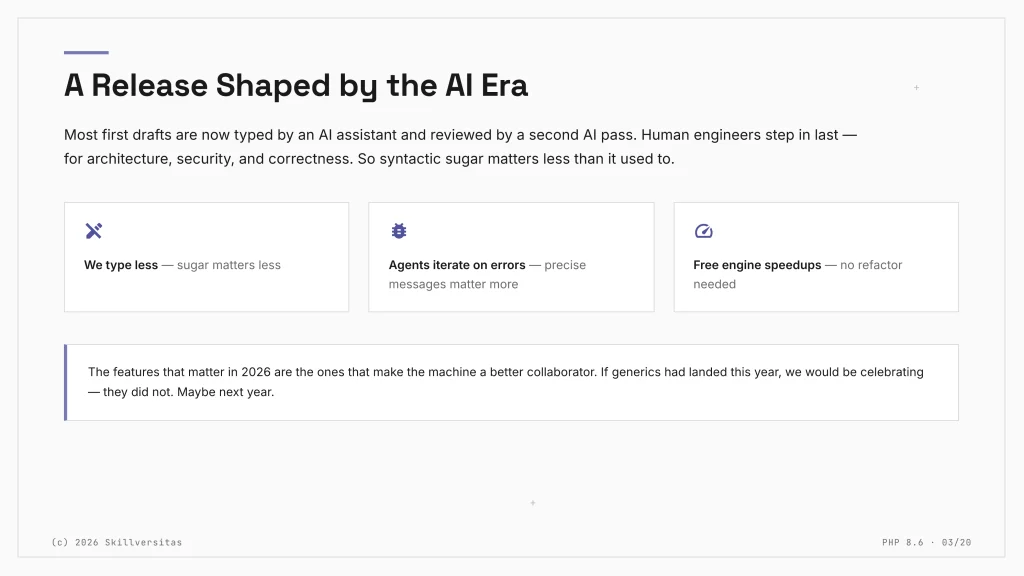
A few years ago, a feature like partial function application would have made us giddy. We would have spent a weekend refactoring codebases just to use it. But the way we work has changed. These days, most of the first draft of our code is typed by an AI assistant, reviewed by another AI pass, and then read by a human engineer who focuses on architecture, security, and correctness. We simply don’t look at syntactic sugar the way we used to, because we don’t type as much of it by hand anymore.
That doesn’t mean PHP 8.6 is a boring release. Far from it. It just means the features we’re most excited about are the ones that make the machine a better collaborator: error messages that tell you exactly where things broke, exceptions instead of silent warnings, and functions that get faster without you touching a line. PHP 8.6 delivers plenty of that. And to be clear: if generics had landed in this release, we’d be throwing a party. They didn’t. Maybe next year.
With that lens in place, let’s walk through what’s actually new.
Partial function application: the headline feature
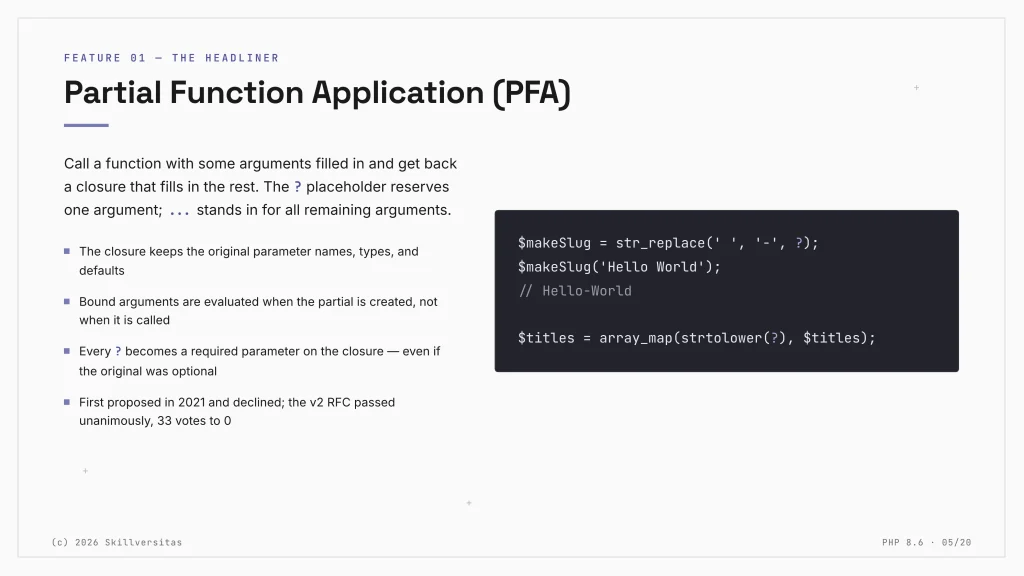
Partial function application (PFA) lets you call a function with some arguments filled in and get back a closure that fills in the rest. The ? placeholder marks a single argument to be supplied later, and ... stands in for all remaining arguments:
 $makeSlug = str_replace(' ', '-', ?);
 $makeSlug('Hello World'); // Hello-World

 $titles = array_map(strtolower(?), $titles);
The closure you get back keeps the parameter names, types, and defaults of the original function, so IDEs and static analyzers stay happy. Arguments you pass in are evaluated when the partial is created, not when it’s called. One detail worth knowing: every ? placeholder becomes a required parameter on the resulting closure, even if the original parameter was optional.
If this sounds familiar, that’s because a first version of this proposal was declined back in 2021. The reworked RFC passed unanimously this year, 33 votes to 0, and it slots perfectly into the pipe operator that arrived in PHP 8.5. Piping always demands a callable that takes exactly one argument, and PFA finally gives you a clean way to build those inline.
$output = 'Hello World'
    |> str_replace(' ', '-', ?)
    |> strtolower(...);
// hello-world
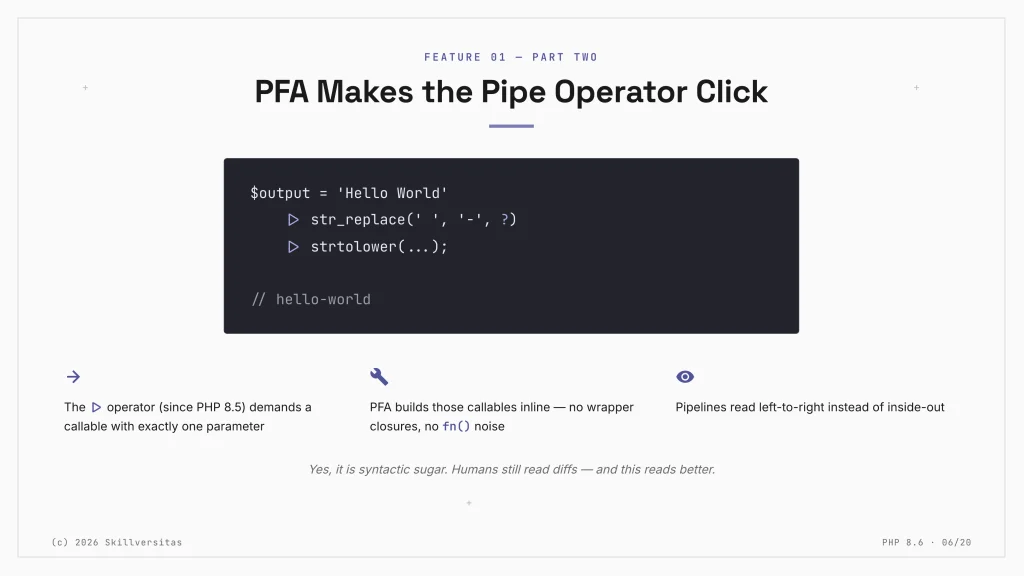
Is it syntactic sugar? Yes. Will an AI care whether you used it or a short closure? Not really. But humans still read diffs, and a pipeline you can scan left-to-right reads better than three nested callbacks. We’ll use it where it clarifies, and ignore it where it doesn’t.
clamp(): the end of the min(max()) dance
If you’ve ever written min(max($value, $min), $max) and then spent a minute wondering whether the nesting order was right, PHP 8.6 has a gift for you:
clamp(10, min: 0, max: 100);   // 10
clamp(101, min: 0, max: 100);  // 100
clamp(-1, min: 0, max: 100);   // 0
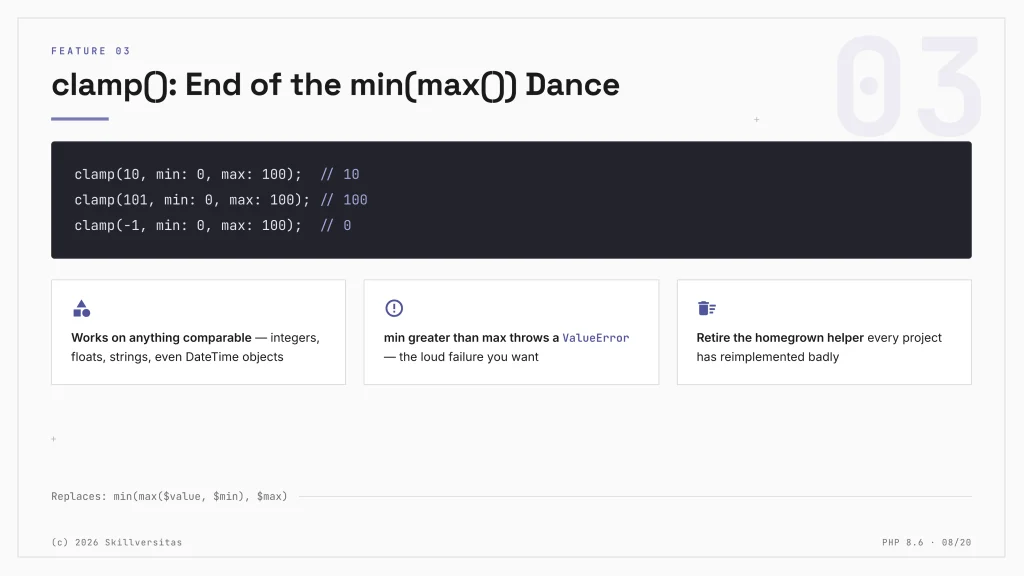
The new clamp() function returns the value if it’s within bounds, or the nearest boundary if it isn’t. It works on anything comparable: integers, floats, strings, even DateTime objects. Pass a minimum greater than the maximum and you’ll get a ValueError, which is exactly the loud failure you want. This used to be one of those helper functions every project reimplemented badly. Now it’s in the language, and one more piece of our internal utility bag goes in the bin.
Time\Duration: a proper value object for time spans
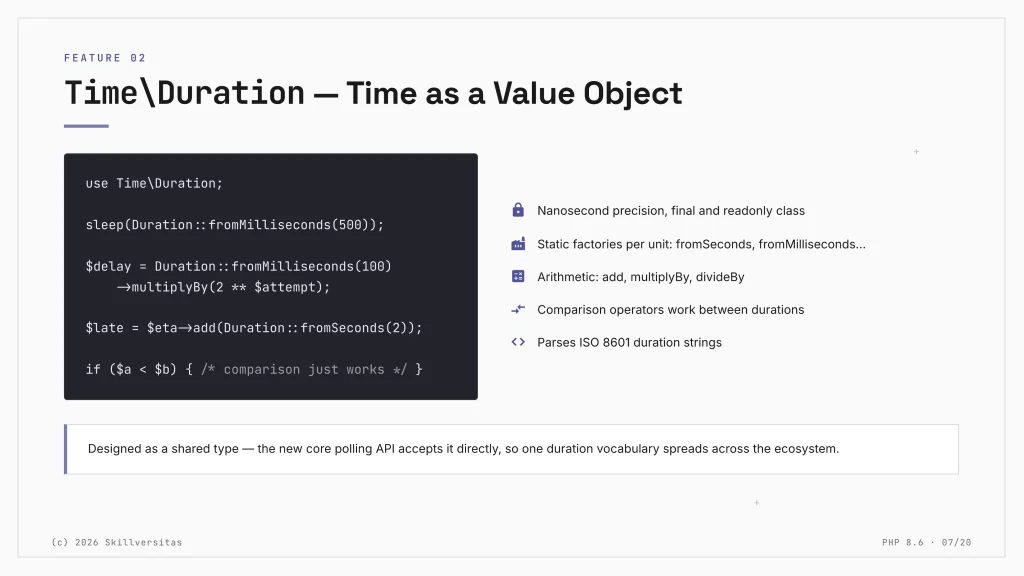
The new Time\Duration class represents a length of time with nanosecond precision, and it’s a genuinely delightful piece of API design:
use Time\Duration;

sleep(Duration::fromMilliseconds(500));

 $baseDelay = Duration::fromMilliseconds(100);
 $delay = $baseDelay->multiplyBy(2 ** $attempt); // exponential backoff
 $delay->add(Duration::fromSeconds(2));

if ($durationA < $durationB) { /* comparison operators just work */ }
It’s a final, readonly value object with static factories, arithmetic methods, direct comparison support, and it can even parse ISO 8601 duration strings. Honestly, looking back at the loose integer-with-a-unit-comment approach we all used for retry delays and timeouts, it’s hard to remember why we tolerated it for so long. The class is also designed to be shared: core APIs like the new polling system accept it directly, which means we’ll see one consistent duration type across the ecosystem instead of each library inventing its own.
Readonly properties can finally have defaults
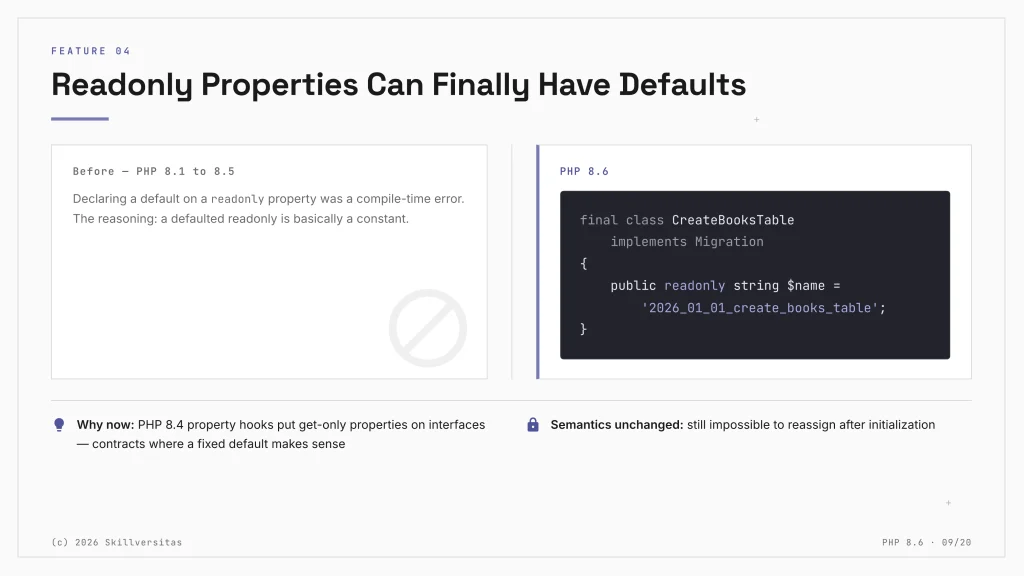
Since PHP 8.1, declaring a default value on a readonly property was a compile-time error, on the logic that a readonly property with a default is basically a constant. That logic was sound until PHP 8.4 introduced property hooks on interfaces, and suddenly you had contracts like public string $name { get; } where a fixed default value made perfect sense:
final class CreateBooksTable implements Migration
{
    public readonly string $name = '2026_01_01_create_books_table';
}
PHP 8.6 simply removes the restriction. The readonly semantics are unchanged; the property still can’t be reassigned after initialization. It’s a small fix that removes a daily annoyance, and we’ve already hit this exact wall more times than we can count.
The quiet quality-of-life batch
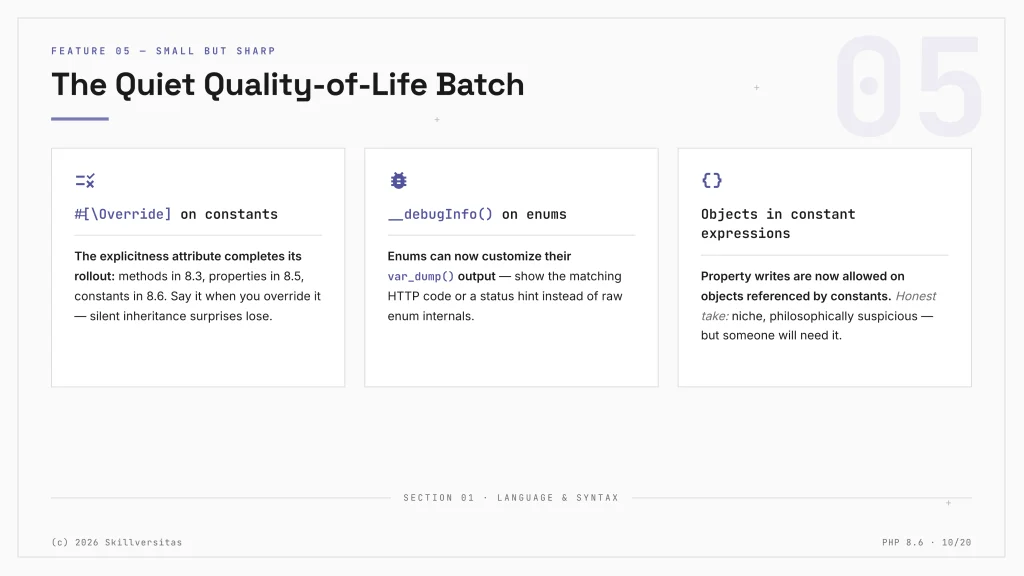
Several smaller additions round out the language, and a few of them deserve more attention than their size suggests:
#[\Override] on class constants. PHP 8.3 let you mark overridden methods with the Override attribute, PHP 8.5 extended it to properties, and PHP 8.6 completes the set with constants. If you inherit from a parent class or interface and override a constant, you can now say so explicitly. We’re not fans of deep inheritance in general, but when it exists, explicitness beats silent surprises every time.
Debugable enums. Enums can now implement __debugInfo(), so a var_dump() of a status enum can show something meaningful (like the associated HTTP code) instead of just the case name. Tiny feature, but anyone who has squinted at a dump full of enum internals will appreciate it.
Objects in constant expressions. PHP 8.6 also allows writing to properties of objects that are referenced by constants. We’ll be honest: we don’t have a compelling use case for this one yet, and a constant that you can mutate feels philosophically suspicious. If you have a real scenario for it, we’d genuinely like to hear about it.
A global SortDirection enum. A built-in, always-available enum with two cases, Ascending and Descending, that libraries can adopt for sorting APIs. Core functions like array_multisort() don’t accept it yet, but the intent is clearly for the standard library to standardize on it over time. One shared vocabulary beats seventeen competing string conventions.
URI extension follow-ups. The standards-compliant URI extension that shipped with PHP 8.5 gains builder classes for both the RFC 3986 and WHATWG URL flavors, which makes constructing and modifying URIs far less error-prone than the old parse_url gymnastics.
Reflection upgrades. New isReadable() and isWriteable() methods on ReflectionProperty, with scope-aware checks so a private property correctly reports as readable only from inside its class. On top of that, doc comments can now live directly on function parameters and be read via ReflectionParameter::getDocComment(), which is a quiet win for static analyzers.
Debugging is where PHP 8.6 really shines
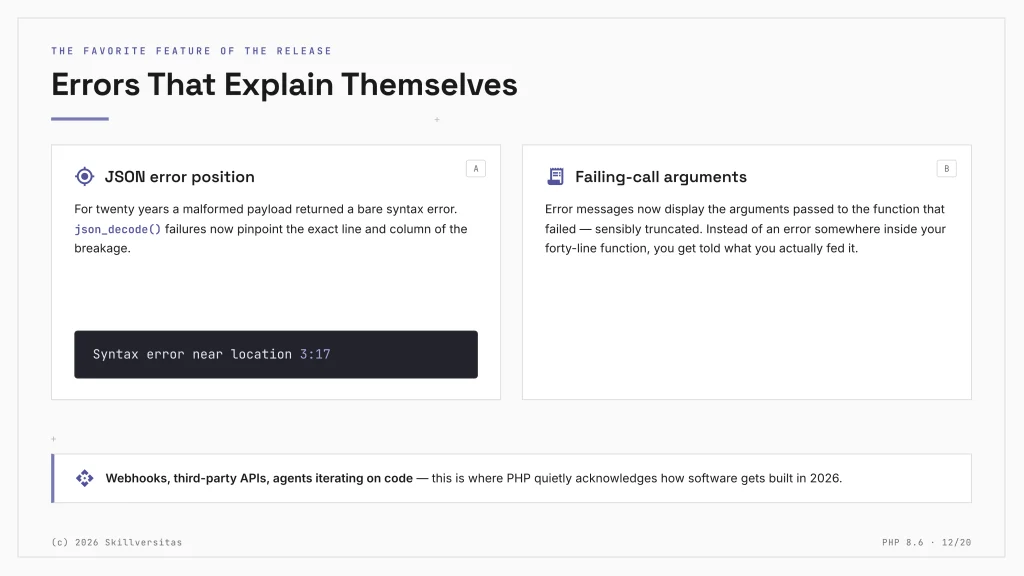
This is the section we care about most, because it’s where this release quietly acknowledges how software gets built in 2026: by humans supervising machines. When an AI agent (or a tired human at 2 a.m., let’s be fair) is iterating on code, the difference between a vague error and a precise one is the difference between one retry and an hour of archaeology.
JSON errors finally tell you where you are. For twenty-plus years, a malformed payload gave you a generic syntax error and nothing else. Now the error message from json_decode() pinpoints the exact line and column of the failure. If you integrate webhooks or third-party APIs, you know precisely how much pain this removes. It’s probably our favorite feature in the entire release, and it’s barely a paragraph in the official changelog.
Errors display the arguments of the failing call. Related and equally agent-friendly: error messages now show the arguments that were passed to the function where the failure occurred, with sensible truncation. Instead of an error somewhere inside your forty-line function, you get told what you actually fed it.
Stream errors grow up. The classic warning about a failed stream open followed by a lone false return is the stuff of nightmares. PHP 8.6 introduces a comprehensive stream error handling system: new context options let you opt into exception-based behavior, and new classes and functions, including stream_last_errors() and stream_clear_errors(), give you structured access to what went wrong. Failures become catchable, loggable, retryable. The way I/O should always have worked.
The new Polling API: plumbing that matters more than it looks
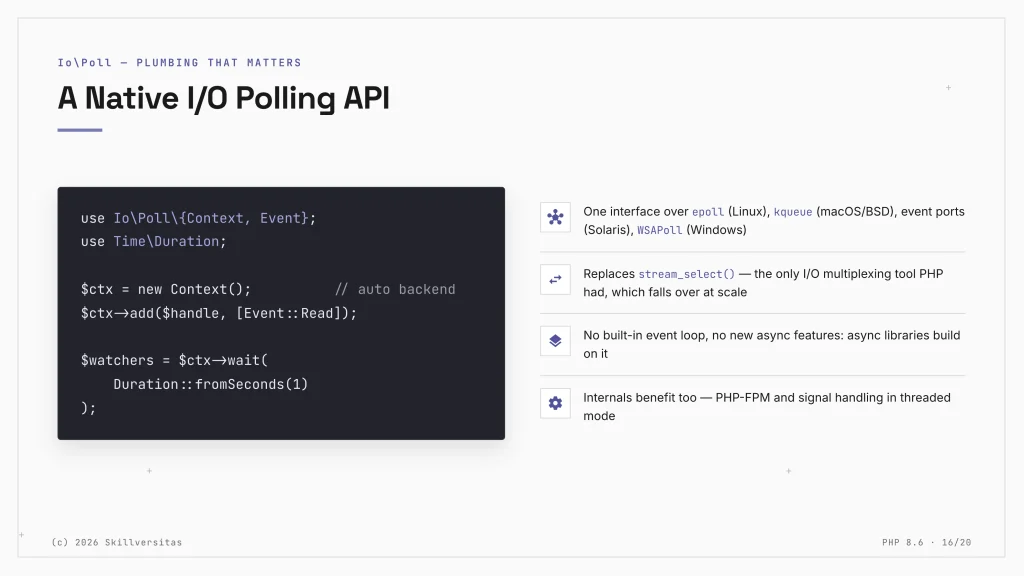
Buried near the bottom of most summaries is a feature that could reshape the async ecosystem: a native I/O polling API in the Io\Poll namespace. It gives PHP a unified interface to the platform-native mechanisms: epoll on Linux, kqueue on macOS and BSD, event ports on Solaris, and WSAPoll on Windows. Previously, the only tool available for I/O multiplexing was stream_select(), which falls over at scale.
Let’s set expectations properly: this does not add async to PHP, and it doesn’t ship an event loop. What it does is give the developers of event-loop libraries a fast, portable foundation to build on, and it modernizes internals like PHP-FPM and signal handling in threaded mode. If you run conventional request-response apps, you won’t touch it directly. You’ll just benefit from the frameworks that do.
Performance: faster where it counts, with one config surprise
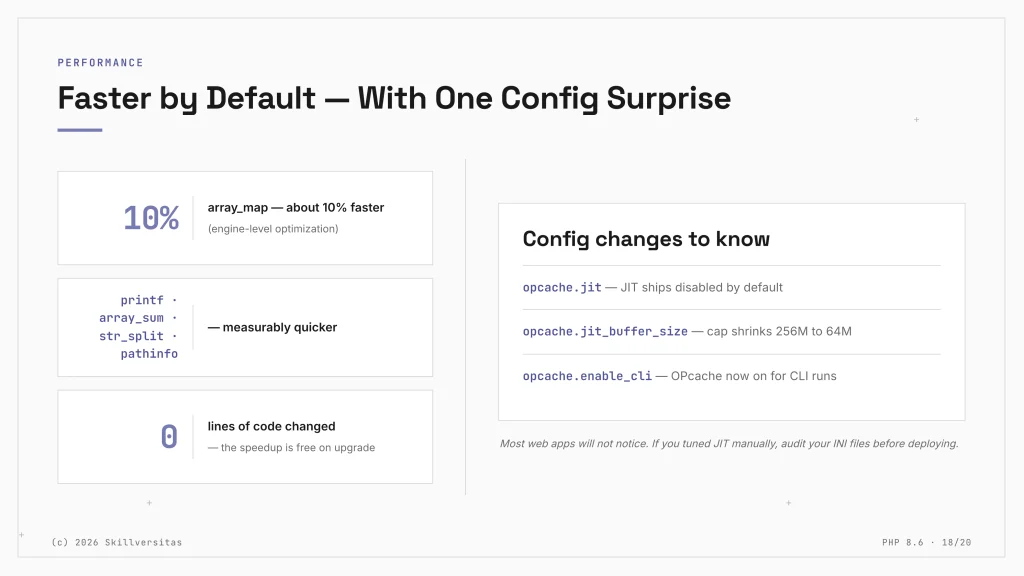
The engine team delivered again. Community benchmarks put array_map roughly 10% faster on PHP 8.6 thanks to engine-level optimization, with printf, array_sum, str_split, and pathinfo among the other functions that got quicker. Your code speeds up for free when you upgrade. That’s the best kind of performance work.
One operational detail almost everyone will miss: the OPcache defaults changed. The JIT now ships disabled by default, with the JIT buffer limit shrinking from 256M to 64M, and OPcache itself is now enabled for CLI runs. If your infrastructure explicitly relied on JIT settings, audit your INI files before deploying. Most web applications won’t notice, but now you know why your benchmarks might look different.
Sessions are secure by default now
PHP 8.6 flips three session INI defaults to secure values: session.use_strict_mode and session.cookie_httponly now default to 1, and session.cookie_samesite defaults to Lax. This is unambiguously good for the ecosystem, and it deserves a loud warning label anyway, because behavior changes can break assumptions.
If your app accepts a session ID supplied from elsewhere, say a hand-off between subdomains, strict mode will reject IDs that don’t already exist on the receiving side. Close and write the session on the originating side first. JavaScript can no longer read the session cookie via document.cookie, so if some legacy script embedded the session ID into a request header, move that to a proper CSRF token. And cross-site POST flows, certain single-sign-on patterns and legacy form posts, won’t carry the cookie under Lax, so those endpoints need an explicit SameSite=None; Secure setting or a token-based redesign.
Audit your authentication and SSO flows before upgrading. Most major browsers already treat Lax as their implicit default, so for many of you this change just makes explicit what was already happening.
The 26 deprecations: cleanup, not crisis
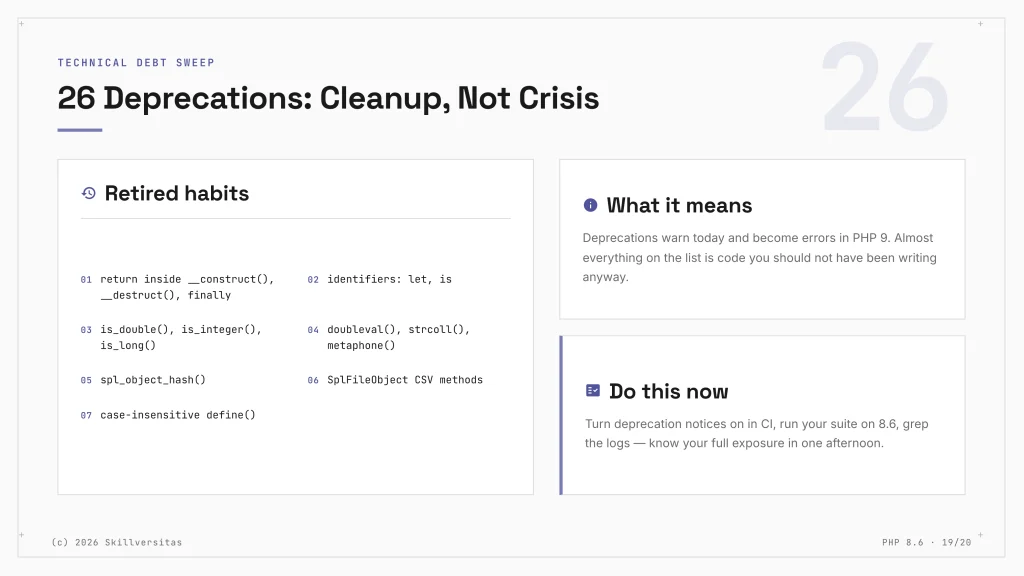
PHP 8.6 deprecates 26 things, and scanning the list is a pleasant experience because nearly all of it is code you shouldn’t be writing anyway. Returning a value from a constructor, destructor, or finally block is deprecated. Naming things let or is, reserved for future keywords, is deprecated. The ancient is_double(), is_integer(), and is_long() aliases, doubleval(), strcoll(), metaphone(), spl_object_hash(), the CSV methods on SplFileObject, and case-insensitive define() are all deprecated, all with modern replacements.
Note that deprecations don’t break anything today; they emit warnings in your logs that will become errors in PHP 9. The smart move is to fix them now while they’re cheap. Turn your deprecation notices on in CI, grep the logs after your first 8.6 test run, and you’ll know your exposure in an afternoon.
Should you upgrade today?
Here’s the exact playbook we’re following at Skillversitas:
- Wait for your platform. Shared hosting panels, Linux distribution repositories, and managed cloud platforms need a few weeks to ship 8.6 builds. Don’t fight it.
- Test the GA build in staging now. The release candidates were rock solid for us, but staging is where session default changes and INI surprises reveal themselves.
- Sweep for deprecations. Run your test suite with deprecation notices visible and fix what surfaces. It’s an afternoon now or a migration crisis in PHP 9.
- Review JIT and OPcache settings. If you tuned them manually, re-validate. If you didn’t, enjoy the free array_map speedup.
- Go to production after 8.6.1. The first patch release typically sweeps up early-adopter bugs. For production systems, that’s our sweet spot.
Quick answers to the questions we keep getting
Is PHP 8.6 a breaking release? No. It’s a minor version, so nothing stops working outright. The two behavioral areas to actually test are the new session defaults and your OPcache/JIT configuration. Everything else is additive or warning-level.
What’s the single best feature? For teams shipping with AI assistance: the JSON error position and the richer error messages. For everyone else: the free performance gains and clamp().
Do I need to refactor to benefit from the speed improvements? No. The optimizations live inside the engine’s function implementations. You update, things get faster, you move on with your life.
Conclusion
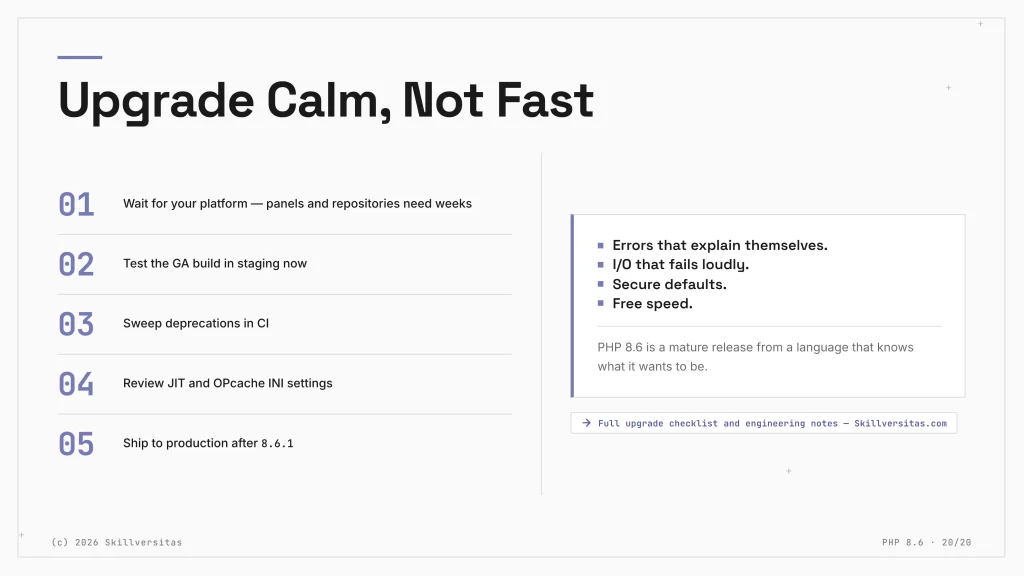
PHP 8.6 is a mature release from a language that knows what it wants to be. Partial function application will dominate the blog headlines, but the lasting value is underneath: errors that explain themselves, I/O that fails loudly and legibly, secure defaults, and engine work that pays dividends on every request. The PHP internals team had a clear thesis this year, making the language better for the way code is actually written and debugged in 2026, and they executed it.
We’ve already rolled it out across our staging fleet at Skillversitas.com, and production follows as soon as the ecosystem catches up. PHP keeps quietly getting better at exactly the things that matter, and we’re happy to keep betting our stack on it.
Want the rest of our PHP 8.6 upgrade checklist, including the CI deprecation sweep we run before every version bump? Visit Skillversitas.com.