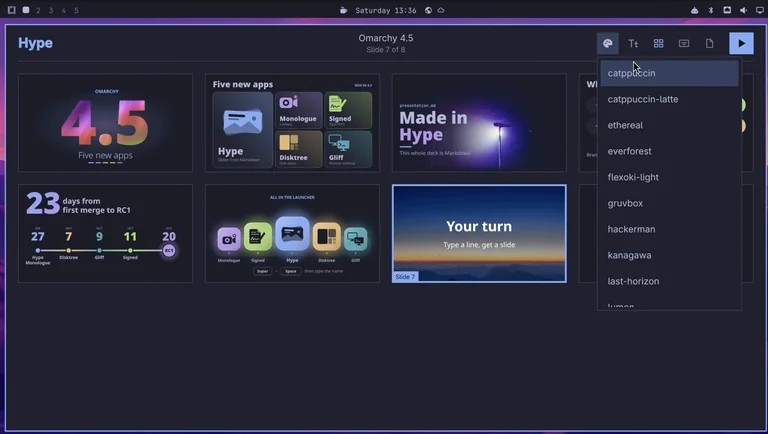
We have reached a saturation point with the standard “Chatbot” interface. For the past two years, the industry has been obsessed with wrappers, prompts, and RAG pipelines that essentially just return text. But anyone building serious production systems knows that text is a dead end if it cannot act. Nuno Maduro, a name synonymous with high-quality developer experience in the Laravel ecosystem, recently unveiled Omarchy. It is being positioned as the world’s first “Agentic Operating System,” and while that sounds like marketing hyperbole, the technical shifts happening under the hood suggest we are looking at a fundamental reorganization of how software interacts with hardware and APIs.
The core premise of Omarchy moves us away from the LLM as a “service” and toward the LLM as a “kernel.” If you look at Andrej Karpathy’s conceptualization of the LLM OS, the idea is that the Large Language Model acts as the CPU, managing resources, calling tools as peripheral devices, and maintaining a context window as volatile memory. Omarchy takes this theoretical framework and attempts to turn it into a concrete, programmable reality.
Beyond the Orchestration Layer
Most developers are currently stuck in the “LangChain trap,” building brittle chains of logic that break the moment a model hallucinates a single JSON key. Omarchy seems to be tackling this by treating agents not as mere scripts, but as persistent entities within a managed environment. In a traditional operating system like Linux or macOS, the OS provides a set of primitives: file systems, networking, and process management. Omarchy provides these same primitives but optimized for non-deterministic agents.
When we talk about an “Agentic OS,” we are talking about a system that manages the lifecycle of an agent. This includes state persistence, which is notoriously difficult. If an agent is halfway through a multi-step task like refactoring a legacy codebase or managing a cloud deployment, and the connection drops or the token limit is hit, what happens? In a standard script, the state is lost. In an agentic OS environment, the state is serialized. The “memory” of the agent is treated as a first-class citizen, allowing for long-running processes that can “sleep” and “wake” based on external triggers or human-in-the-loop approvals.
The Technical Friction of Autonomy
The most interesting, and perhaps most dangerous, aspect of Omarchy is its focus on tool integration. Nuno Maduro’s background with tools like Pest and Termwind suggests a deep understanding of terminal-based interaction. Omarchy allows agents to execute commands, interact with the file system, and potentially manage other software processes. This is where the “Agentic” part becomes real. An agent that can only talk is a consultant; an agent that can run git commit or docker-compose up is an engineer.
However, this level of autonomy introduces a massive security surface area. We are essentially giving a non-deterministic model a shell. The trade-off here is between capability and safety. To make Omarchy viable for the enterprise, there must be a robust “sandbox” architecture. You cannot simply let an LLM run rampant on a production server. The OS must implement strict permissions, likely through a capability-based security model where the agent only has access to specific “tools” or directories defined by the user.
Why PHP and the Laravel Ecosystem Matter Here
It might seem counterintuitive to see an AI-first operating system emerging from the PHP world, a language often unfairly maligned by the “AI-research” crowd. But if you look at the history of web development, PHP is the language of pragmatism. Laravel, in particular, excels at taking complex concepts and turning them into elegant, developer-friendly APIs.
By building Omarchy with these sensibilities, Maduro is democratizing agentic workflows. You don’t need a PhD in Machine Learning to build a system that can autonomously manage your GitHub issues or monitor your server health. You just need to understand how to register tools and define goals. This “Developer Experience” (DX) focus is what was missing from the early, clunky iterations of AutoGPT or BabyAGI. Those were proofs of concept; Omarchy feels like a tool for builders.
The Long-Term Implication: The Death of the UI?
If Omarchy and the concept of Agentic Operating Systems take off, we have to question the future of the traditional Graphical User Interface (GUI). If an agent can navigate the “OS” to perform tasks, why do I need a dashboard? We are moving toward a “Headless Computing” model. In this world, the OS doesn’t exist to show you icons; it exists to provide a playground for agents to solve problems on your behalf.
But let’s be realistic. We are still battling the “latency wall.” Every “thought” the agent has, and every tool it calls, incurs a cost in both time and money. An agentic OS running on GPT-4o or Claude 3.5 Sonnet is powerful but expensive. For Omarchy to become the “daily driver” for developers, we need to see it integrated with local LLMs via Ollama or vLLM. Running an agentic OS on top of a local Llama 3 instance would provide the privacy and speed necessary for true system-level integration.
Omarchy is a bold bet on the idea that the future of software isn’t just “AI-powered,” but “AI-governed.” It’s a shift from software that waits for a click to software that looks for a goal. Whether it becomes the standard or remains a niche tool for the Laravel elite remains to be seen, but the direction is unmistakable: the kernel is changing, and the agents are taking over the shell.